
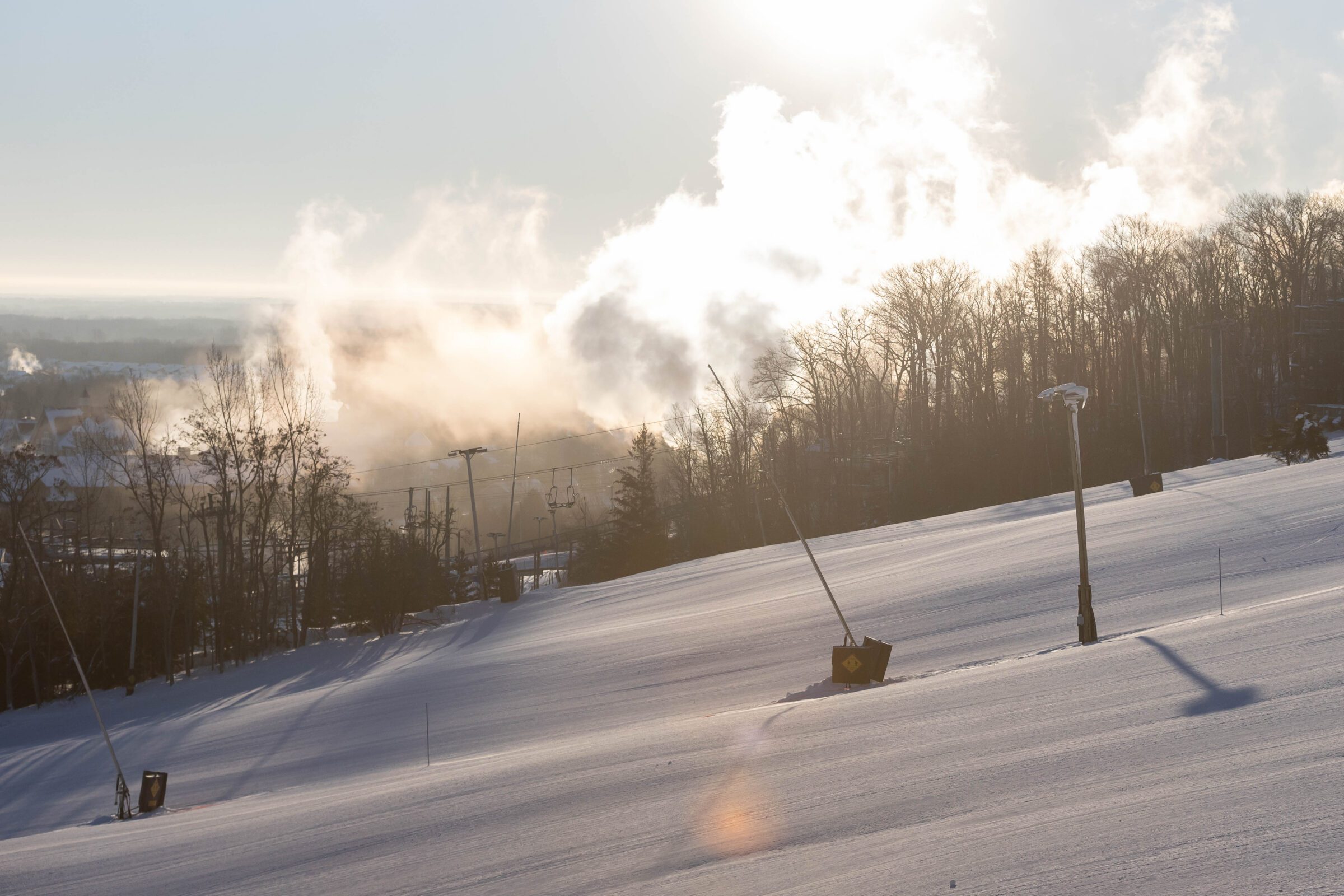
Nothing beats natural snow, but in southern Ontario, we can’t consistently count on it—especially during an El Niño winter. That’s where snowmaking fills the gaps. It plays a massive role leading up to Opening Day and throughout the season whenever Mother Nature falls short.
The Science of Snowmaking When conditions are right and high-pressure water is combined with compressed air and forced through a specialized nozzle, magic happens. Millions of tiny water droplets quickly freeze before reaching the ground, creating snow.
So, can we make snow the second the air drops below freezing? Not quite.The Blue Mountain operations team closely watches a metric called the wet-bulb temperature. It combines air temperature and relative humidity to determine exactly when the snow guns can fire and how efficient they will be.
· Around -2.5°C: Once the wet-bulb dips below this mark, we are officially in business.
· Below -7°C: The snow becomes drier, accumulates faster, and is much easier for our grooming team to push around.
· Between -7°C and -12°C (with light winds): This is the ultimate sweet spot. It’s what snowmakers dream about—and as a skier or rider, maybe you should too!
Where Does the Water Come From? The water used to make all this snow comes from Georgian Bay and Blue Mountain’s own reservoirs. The colder the water starts out, the better. It is pumped through a massive network of underground pipes, up the escarpment, and out through nozzles mounted on elevated towers. Increasing that hang time maximizes the chance for droplets to freeze, allowing us to make snow even in marginal conditions.
Best of all, it’s a closed-loop cycle. When a mid-winter thaw hits or the spring melt arrives, all that water flows right back into our reservoirs and Georgian Bay.
When Will the Snow Guns Fire? Right now, the weather pattern remains very mild for this time of year, though long-range signs point toward a pattern change by the end of November. Our operations team is keeping a close eye on the forecast, ready to jump on that first cold-weather window. When it arrives, millions of dollars in recent Blue Mountain Resort snowmaking investments and tech upgrades will make an immediate impact—putting more snow on the trails, faster than ever. And in an El Niño winter, that makes all the difference.
Senior Meteorologist,
Anthony Farnell